I volunteered to teach art to K-6th grade at a small private school. Here's OUR story.
Wednesday, May 4, 2011
Making your own coat of arms
Inspired a bit by the 5th and 6th grade study of medieval history, I had the kids make their own coat of arms. Similar to project I did two years ago having the kids make their own flag, this requires them to think about their own identity and visualize it.
To inspire them I brought in a few completes coats of arms as well as some print out of the various elements thata re common and colors.
They first folded a piece of paper in half and drew half a shield and cut it out so the result would be symetrical.
Then they had to decide on their 1-3 favorite colors, shapes and insignia. I aked them if they had a favorite animal or toy or other item taht they could easily draw. Or they could draw an animal that represented their pesonality.
Many horses, lions and Star Wars figures resulted;-)
Tuesday, May 3, 2011
Chinese Scroll Painting
As a knod to Chinese New Year, I brought in some long scroll paintings that I had purchased in China in the 1990s. I was inspired by the beautiful flower plum trees, so also brought in a vase of plum branches.
I folded long white contruction paper in half so the kids had the tall canvas. Trying to emphasize the distorted perspective that is common in these paintings, I had the kids use their watercolors to make mountains and a river that stretched down from the top. If they wanted they could add some trees and houses or boats, but the main objective was the tall skinny landscape.
Then in the foreground they were to draw a tree with their black marker (the paper was still wet, so this mad ea nice wet-on-wet technique too.) For flowers they got pink tissue paper and made little balls to
glue onto the branches.
A finishing touch was a red square with their initials to mimic the "signature" stamp.
Sunday, May 1, 2011
Star Wars Collage
For those Star Wars fans in my art classes. This is for you!
Jeremy Messersmith - Tatooine from Eric Power on Vimeo.
Week 17: Valentines
The age-old question of what to do for Valentines Day? So many fun crafty things. This year I had the kids do "snowflake" Valentine compositions in paper. They choice a couple red, pink, white etc sheets and folded them like you would a snowflake and then cut out heart shapes. If they were lucky they would get some fun inticate shapes. If not, they would at least have 8 hearts on the table that they then could still use to make a collage. I tried to get them to layer larger pieces under and smaller on top.
4th Grade mission projects
This may be an off-topic, but related post. While this did not happen in my art class, I did want to highlight the very nicely done California Mission Models that the kids built in the 3rd/4th grade room! Not all the kids did Missions, since several did history videos, maps or ship models.
I'm a huge Mission model fan, going all the way back to my 4th grade Mission Santa Barbara. My son Devon (and I) built Mission Carmel.
Sunday, March 13, 2011
What Art teaches our kids
In my weekly round of other art teacher blogs, I came across this nice list of things that art teaches students. It is a distilation of a speach by Elliot Eisner, an Art Professor at Stanford. It was on Hands-On Art, a blog I frequent for inspiration. These same lessons can be learned via music, sports and drama etc, but Art is inherently an easy way to achieve these goals without regard to resources or talent.
10 Lessons the Arts Teach (by Elliot Eisner)
2. The arts teach children that problems can have MORE THAN ONE SOLUTION and that questions can have more than one answer.
3. The arts celebrate MULTIPLE PERSPECTIVES. One of tehir large lessons is that there are many ways to SEE AND INTERPRET the world.
4. The arts teach children that in complex forms of problem solving purposes are seldom fixed, but change with circumstance and opportunity. LEarning in the arts requires the ABILITY and WILLINGNESS to surrender to the unanticipated possibilities of the work as it unfolds.
5. The arts make VIVID the fact that neither words in their literal form nor numbers exhaust what we can KNOW. The limits of our language does not define the limits of our COGNITION.
6. The arts teach students that SMALL DIFFERENCES can have LARGE EFFECTS. The arts traffic the subtleties.
7. The arts teach students to think through and within a material. All art forms employ some means through which IMAGES become REAL.
8. The arts help CHILDREN LEARN to say what cannot be said. When children are invited to disclose what a work of art helps them FEEL, they must reach into their POETIC capacities to find the words that will do the job.
9. The arts enable us to have EXPERIENCE we can have from no other source and through such experience to DISCOVER the range and variety of what we are capable of FEELING.
10. The arts' position in the school curriculum symbolizes to the young what adults BELIEVE is IMPORTANT.
10 Lessons the Arts Teach (by Elliot Eisner)
1. The arts teach children GOOD JUDGEMENT about qualitative relationships. Unlike much of the curriculum in which correct answers and rules prevail, in the arts, it is judgment rather than rules that prevail.
2. The arts teach children that problems can have MORE THAN ONE SOLUTION and that questions can have more than one answer.
3. The arts celebrate MULTIPLE PERSPECTIVES. One of tehir large lessons is that there are many ways to SEE AND INTERPRET the world.
4. The arts teach children that in complex forms of problem solving purposes are seldom fixed, but change with circumstance and opportunity. LEarning in the arts requires the ABILITY and WILLINGNESS to surrender to the unanticipated possibilities of the work as it unfolds.
5. The arts make VIVID the fact that neither words in their literal form nor numbers exhaust what we can KNOW. The limits of our language does not define the limits of our COGNITION.
6. The arts teach students that SMALL DIFFERENCES can have LARGE EFFECTS. The arts traffic the subtleties.
7. The arts teach students to think through and within a material. All art forms employ some means through which IMAGES become REAL.
8. The arts help CHILDREN LEARN to say what cannot be said. When children are invited to disclose what a work of art helps them FEEL, they must reach into their POETIC capacities to find the words that will do the job.
9. The arts enable us to have EXPERIENCE we can have from no other source and through such experience to DISCOVER the range and variety of what we are capable of FEELING.
10. The arts' position in the school curriculum symbolizes to the young what adults BELIEVE is IMPORTANT.
Here he is on YouTube about art. click here to watch.
Thursday, February 24, 2011
Week 15-16: African Kente Cloth
As a project for the school's annual International Luncheon, they study a region...this year was Africa. Parents prepare African food and they spent a month or more studying it.
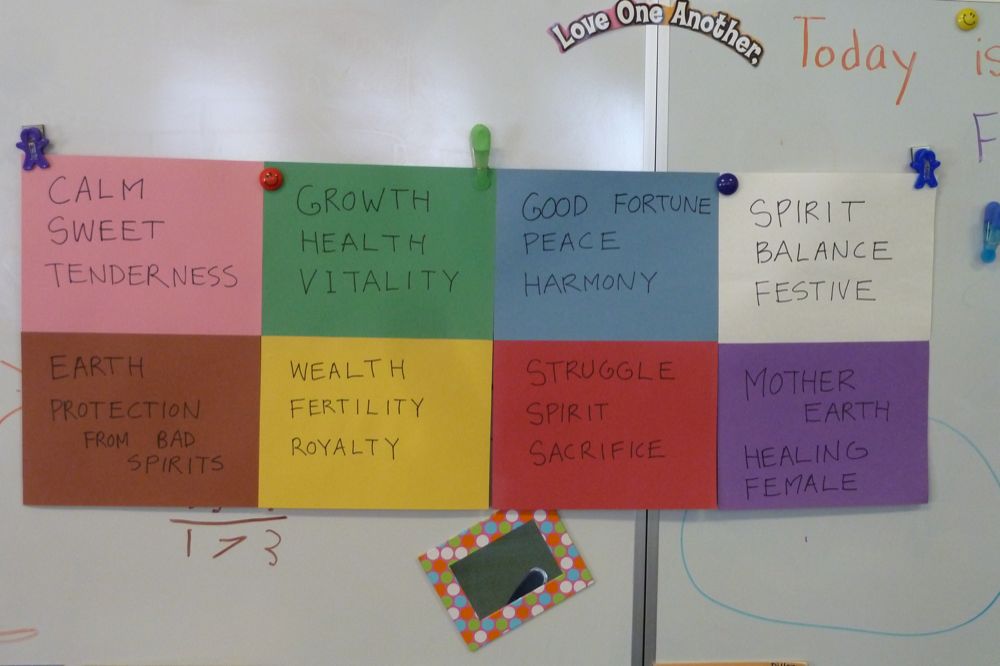
For art, we did "kente cloth" placemats. Kente cloth is a Central African specialty and uses strips of intricately woven cloth in bright colors. It is a ceremonial cloth and well known outside of Africa. Each color has a meaning.
To do this with paper, I used a large brown paper that they folded and then cut slits so it resembled a comb. Use a ruler for spacing. Your goal is to ufold the paper and have it look like a venetain blind but stay in one piece. Then you take 2-3 other colors and cut strip with a ruler. Decorate this strips with a geometric pattern.
Alternating colors, weave the colored strips into the brown paper. When this all done, you can also decorate the brown parts as well. The finishing touch was "laminating" this with contact paper.
Week 14: Pointilism
Back to the late 19th Century we went with a lesson on Pointilism...Suerat and Signac namely. I showed the kids examples of this French Impressionist approach, emphasizing atmosphere, color mixing and lots and lots of little brush strokes!
I had the kids create their own with q-tips and watercolor. This minimized the inherent want to swipe the brush and gave them a fun new utensil to try. While it seemed a bit exhaustive for some, most really embraced the limitation and did a great job.
Week 13: Optical illusion 'Op' art
The first art class of the New Year was a departure from the Christmas crafts! Black and white optical illusion Op Art. I told the kids about the late 20th century artists who created these very geometric, often monochromatic pieces.
We used a rule to find the center of a page of paper. Then I had them draw radiating line outward from that center. Connecting the lines with spider-web-like lines. The most visually interesting onces alternated curving lines so that it almost looks like rippling cloth.
Then they colored every other area black like a warped checkerboard. The kids seemed to enjoy the meditative challenge! Even the younger kids did a good job.

We used a rule to find the center of a page of paper. Then I had them draw radiating line outward from that center. Connecting the lines with spider-web-like lines. The most visually interesting onces alternated curving lines so that it almost looks like rippling cloth.
Then they colored every other area black like a warped checkerboard. The kids seemed to enjoy the meditative challenge! Even the younger kids did a good job.
Monday, December 27, 2010
Week 12: Pop-up Christmas cards
Our last Christmas project was a card for the kids to give to family. The cool twist is that these are pop-ups, which can be really cool, but challenging.
I had two designs (snowman and tree), that I printed onto card-stock to make it easier for the kids. I got the idea from a Christmas Crafts book. They just had to follow directions about cutting and then get some help folding. Then they could decorate and glue into some construction paper for final presentation.
Here is the template. Click for larger file to print.
Week 11: Plastic painted ornaments
With the gracious help of another mother, Mary Maxwell, we did some special ornaments. She had a supplie of clamshell type clear palstic ornaments. They were balls and stars. We had the kids put a few quirts of acrylic paint into the inside of the clear ornaments. (the less, the better) Then they close the ornment snuggly! and shake it around. The result is a marbled look inside.
The only problem is that if the kids use too much paint, it puddles in the bottom and does not dry. Otherwise the kids had a blast. Thanks Mary!
Week 10: Music Note Angel ornaments
I made a template with downloaded sheet music, but you can just photocopy some sheet music or download from the internet. I used "Angels We have Heard on High." Form your sheet music into cones about 3 inches tall with a small hole at the top.
Other items needed:
shiny pipe cleaners
little jingle bells
small flesh colored wood beads. Use Sharpie to put face on.
Small 2-3" shiny or white doilies
glitter
This is what you do:
1. After cones are built, twist a jingle bell on end of pipe cleaner
2. Insert pipe cleaner up from bottom of cone thru "neck hole"
3. Put bead "head" on pipe cleaner
4. Wrap pipe cleaner around finger and twist once or twice to make halo and keep bead on.
5. Use rest of pipe cleaner as hook.
6. Glue half-folded doiley to back of cone as wings
7. Add glitter to bottom of skirt and/or buttons etc.
Subscribe to:
Posts (Atom)